
Jai Japan - #14 - The Chinese Tourist Debate.
Written and shared by Mia Horiguchi San
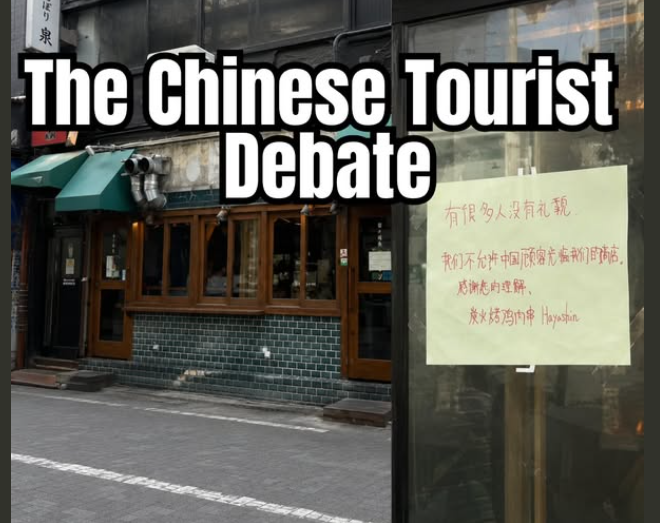
I recently saw news about a restaurant in Osaka reportedly banning all Chinese customers because of “bad manners.” The story spread quickly online, and as expected, many people immediately took sides.
Some supported the restaurant completely.
Others called it discrimination.
Personally, I can understand why emotions are high on both sides.
Japan is experiencing massive tourism growth right now. Popular areas like Osaka, Kyoto, and Tokyo are crowded almost every day. Restaurant staff are exhausted, trains are packed, and many local people feel their quiet daily life is changing very quickly.
When bad experiences happen repeatedly, frustration naturally builds up. And to be honest, bad tourist behavior does exist. Anyone living in Japan long enough has probably seen situations like:
people speaking loudly on trains,
blocking narrow streets for photos,
ignoring local rules,
littering,
or treating public spaces carelessly.
But the problem is… bad manners are not limited to one nationality.
I have personally seen rude behavior from tourists from many different countries, including Western tourists, Southeast Asians, and even local Japanese people themselves.
At the same time, I have also met incredibly polite and thoughtful Chinese tourists in Japan.
Some tried hard to speak Japanese.
Some apologized repeatedly when they made mistakes.
Some showed genuine respect toward Japanese culture.
That is why I feel uncomfortable when an entire group of people becomes labeled because of the actions of some individuals.
Once we start saying:
“All people from this country behave badly,”
we stop seeing human beings as individuals.
And history has shown many times where that kind of thinking can lead. I think businesses absolutely have the right to protect their staff and environment. If customers are rude, aggressive, disruptive, or disrespectful, shops should be allowed to refuse service.
But I personally believe the standard should focus on behavior, not nationality.
Because there is a huge difference between saying:
“Customers who break rules are not welcome,”
and saying:
“People from this country are not welcome.”
One addresses actions.
The other targets identity.
Living in Japan has taught me that this country values harmony deeply. But true harmony cannot come from collective blame or humiliation.
At the same time, foreigners also have responsibility. If we visit or live in another country, we should try to understand local manners, public behavior, and social expectations.
Respect should go both ways. Japan is changing quickly, and social tensions around tourism and immigration will probably continue growing. But I hope people do not lose the ability to separate individuals from stereotypes.
-------------------------------------------
Many people delay their Japan move because they don’t know where to start.
I break everything down in “How to Get a Visa in Japan in Less Than One Year”
— simple, clear, and practical.
Don’t miss it.
-------------------------------------------
To celebrate the launch, we are offering a special limited-time discount:
𝑹𝒆𝒈𝒖𝒍𝒂𝒓 𝑷𝒓𝒊𝒄𝒆: 4000/-
𝑵𝒐𝒘 𝒐𝒏𝒍𝒚: 3500/-
This is designed to help you take action and move closer to your goal of living in Japan. Even if you’re not ready to move yet, this book will help you plan, prepare, and avoid costly mistakes.
To grab your copy WhatsApp here -- > +91-88001-17083
Thank you for reading this post and see you in Japan soon. Note: We consult on job as well as Japanese language learning also. We provide end to end consulting too. Arigato!
-----------------------------------------------------
Written and shared by Mia Horiguchi San

1 Comment